A Briskin Elementary Story
By Martin Mandel
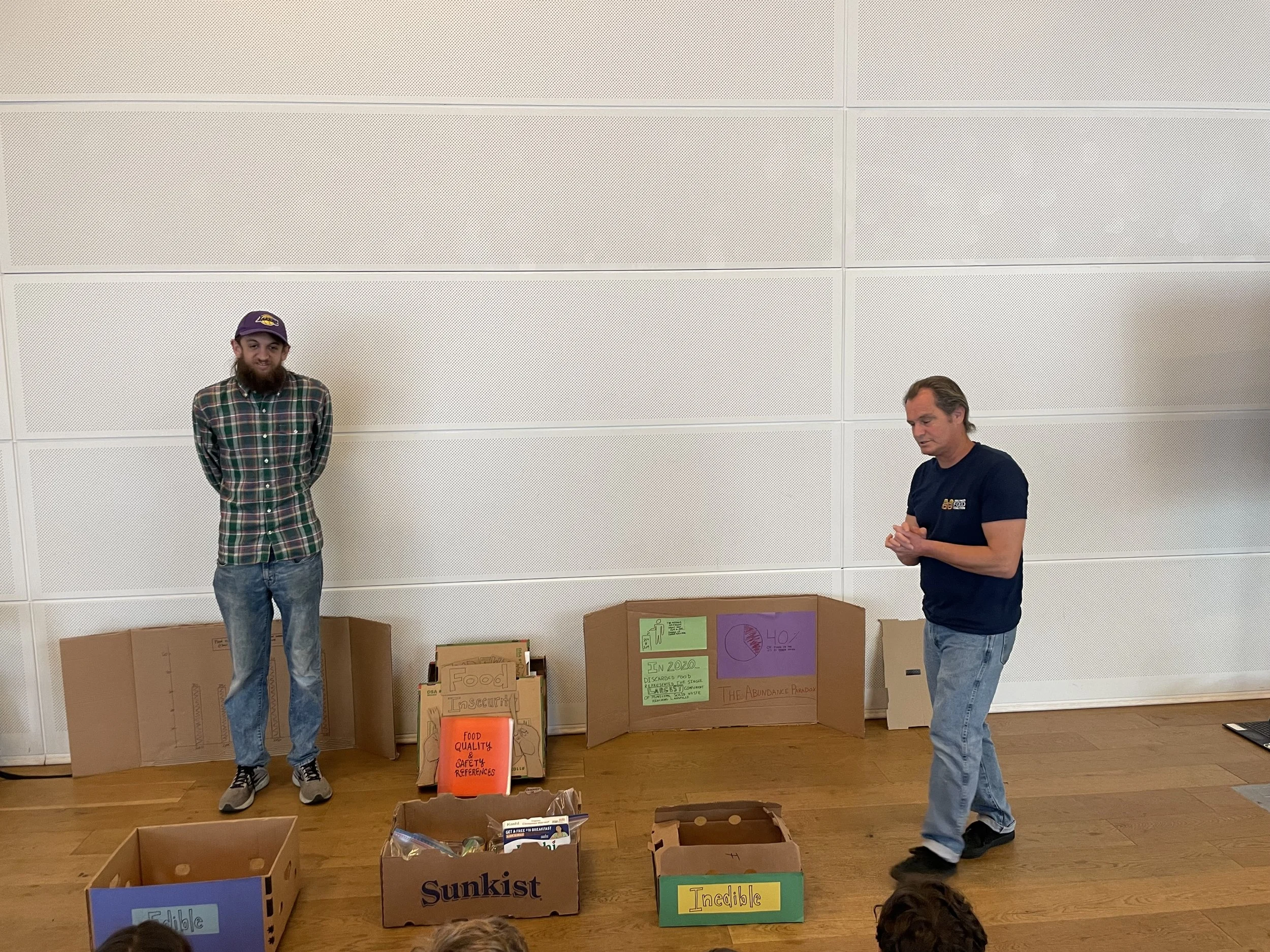
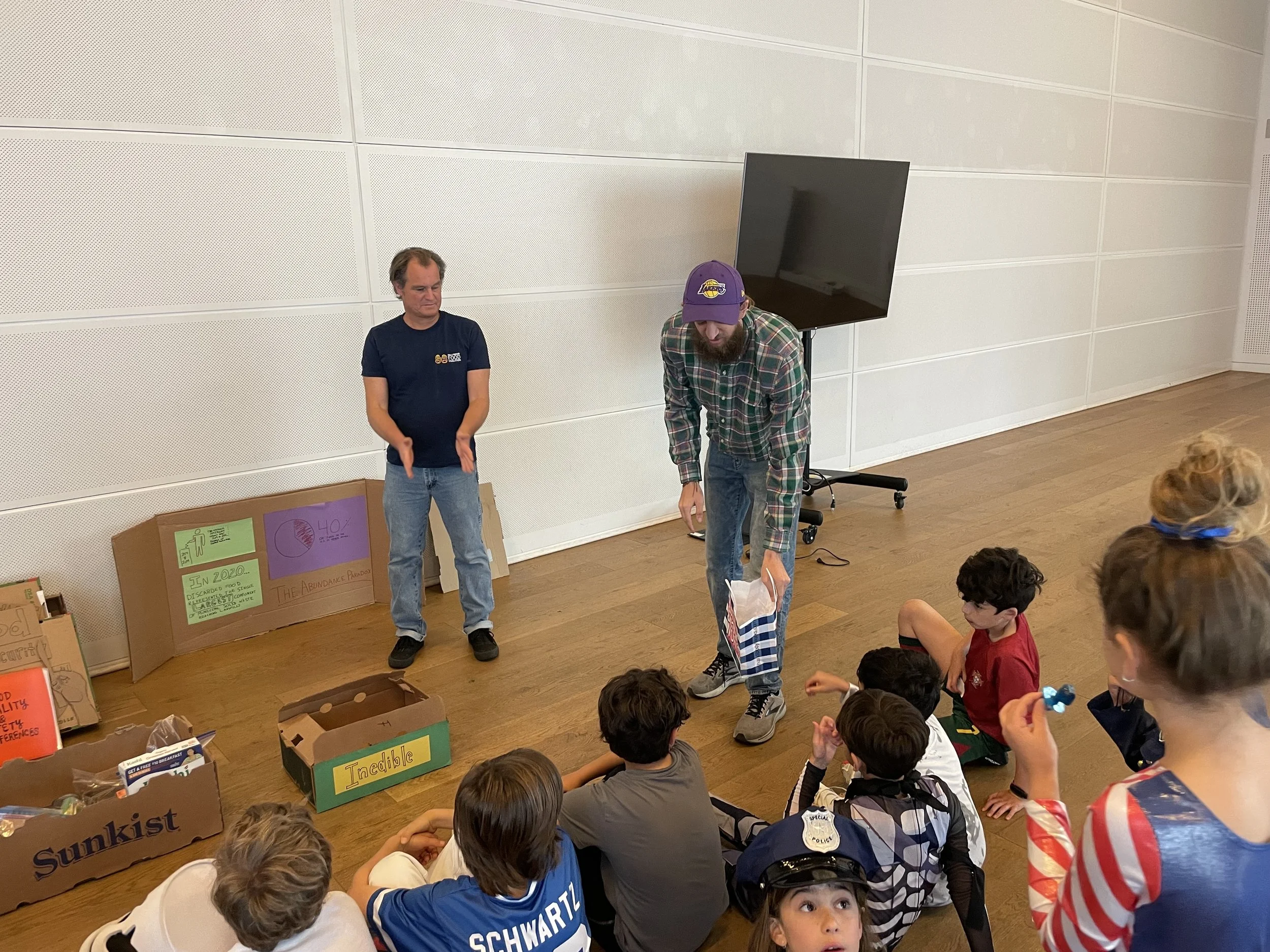
On Friday, March 22nd, 2024, fellow California Climate Action Corps colleague Matt Pearson and I traveled to Briskin Elementary School. Representing Hollywood Food Coalition, our mission was to educate 3rd and 6th Grade Students about the concepts of food insecurity, food waste, and food recovery. Converting Hollywood Food Coalition’s Community Exchange program’s task of sorting food into a game, Matt and I presented a selection of food for the students to identify as edible (fresh) or inedible (stale, rotten, moldy).
Part I - The Sorting Box
“Number 21,” Matt called at random.
A tween raised her ticket, with the digits, and sauntered up to the sorting box housing bags enclosing items of food. She picked a zip lock and raised the bagged box up for her classmates’ eyes to see.
“1… 2… 3..,” I prompted to pace the squinting crowd.
“Would you feed your mother that?” calls all to the demonstrator patiently waiting
She peers at the chocolate chip cookies pictured on the box, unlocks the zip, flips the flap, then looks up.
“Nope,” she confidently responds.
“1…2…3…”
“Prove it!” her classmates crow.
“The bag in the box is open! Would YOU feed YOUR mom previously pilfered cookies?” she sassed back.
And so the introduction to sorting food began a daily routine performed by staff at the Hollywood Food Coalition. The goal is to inspect food for quality, to determine whether donated food is edible or inedible, and whether the intaken food is fit for the community’s needs. Donated food, diverted from landfills, and distributed to people eases communities food insecurity and provides a path toward health and stability.
Part II - The 6th Graders versus the 3rd Graders
A friendly reminder when teaching - 8 year olds live on a different planet than 12 year olds. Deliver the concepts in the correct code. Matt and I needed translators.
Lingering in from break, the sixth graders sat, gendered packs drifting further from center, and each other.
“Move it in,” I prodded,” Stay on this side of the line.”
Ah, a return to a setting where being present conflicts with others being present - within their own age set of course. The dilemma of teaching… pulling people into a reality they are forced to step into. The supervising teachers assisted in the corralling of kids.
As the last students filtered in, Matt doled out the numbered tickets from a Bed, Bath, and Beyond bag. The students chatted, speculating about the numbers.
“Good morning. I’m Marty,” I stated
“I’m Matt,” said Matt
“And we’re from the Hollywood Food Coalition,” we chimed in unison.
The introductory declaration was received with some semblance of attention supported by a mild case of apprehension. Then, the Sorting Box activity commenced. While Matt demonstrated the selection of a fuzzy, green hued lemon, a shimmer of light flickered within the souls of the students. Expressions of disgust brightened the room.
With some encouragement, a ”Would you feed your mother that?” call rippled out from the audience. Matt inspected and shook his head with a hard “no.” An immediate “prove it” response resulted in a “look at it?!” non-verbal Matt reaction.
With that the students began interacting with the bagged food, then the cardboard props, as Matt and I introduced the concepts of Food Insecurity, Food Waste and Food Recovery. A bumpy start finished with a self-assured ending.
Then stepped in the 3rd graders.
Matt and I confidently glided from the vapors of our 6th grade encounter. Unfortunately, the ears of the 3rd graders perceived words flowing from our mouths as letters that may or may not be connected. The students’ internal cogs turned then a raised hand or three shot up to answer our questions. Valiantly, an 8 year old girl teased out words to define “food insecurity.” She was traveling down the right road. Another student was called in for the assist. He, however, took all passengers on a journey down multiple tangents and unexpected tracks. Everyone was lost. Fortunately, a master conductor (the supervising teacher) rolled out a road map to get us all back on track. She explained some people have to make choices between paying for housing or paying for food. MInds meandered some sense of comprehension and the derailment was diverted as the train cobbled safely into the station.
Loading hygiene items into paper bags (aka hygiene kits) concluded the students’ experience of service. A beginning awareness of the basic needs of others.
Part III - A Reflection
Delivering the same ideas and concepts to a variety of audiences is a pause for a thorough understanding of multiple languages. Even within the seemingly homogenous category of “kids,” one has to assess whether learning had a lasting effect. While the sorting activity produced student engagement across age differences, age appropriate analogies and examples were needed to illustrate relevance within the experiences of the audience at attention. From the standpoint of school-age children, I did not completely take into account all the variables. However, I know the next encounter will incorporate the wiser examples of the tenured teachers.